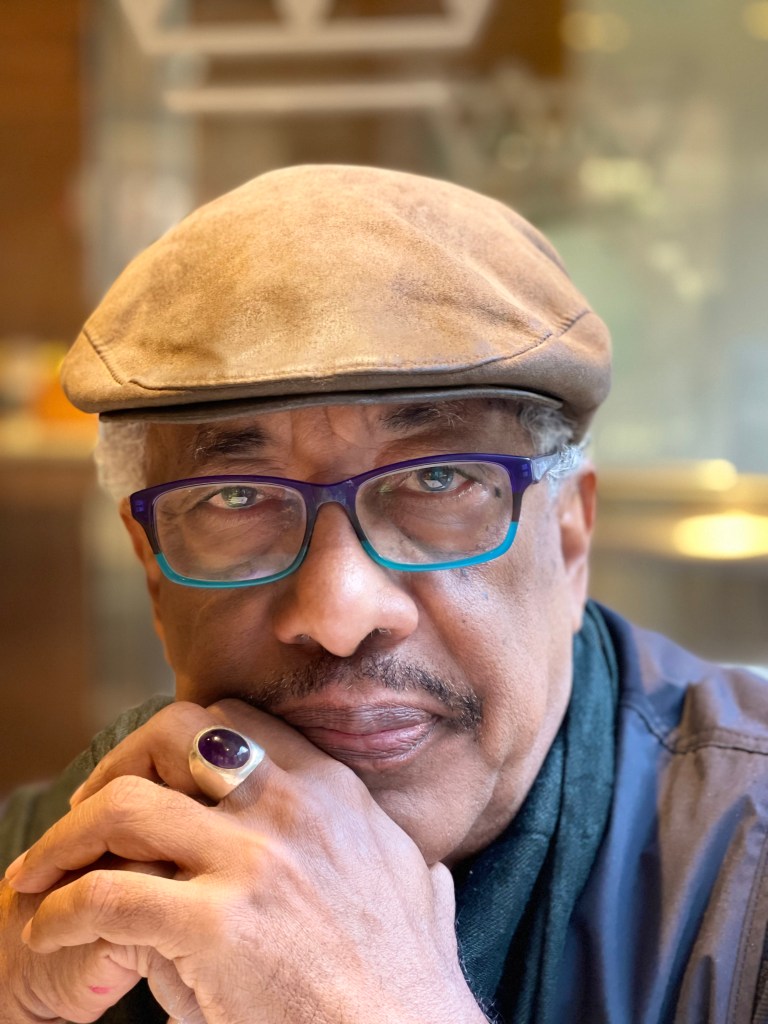


Rashid Diab (1957) was born in Wad-Medani, a town on the bank of the Blue Nile River in Sudan. From a young age concluding that what he wanted to do and could do best was to paint, to become an artist seemed like the only path in his destiny. However in Sudan this is no easy feat. Since his youth he realised that the system in Sudan lacked the instituional support for the arts. There was no place where he could actively pursue his dream of painting.
The only available institution was located in the grand capital city, where a few pioneers of Sudanese contemporary art were already laying the foundations for what would become a historical milestone—integrating visual arts into Sudanese society, culture, and self-expression.
One can view the academic trajectory of Rashid Diab as a historian, philosopher and master of technique in fine art. Critically examining artistic concepts and an aim to procure an atmosphere for the generation of an art scene within the country that could uplift creatives and give them a chance to participate in and develope a national identity. A chance for one to bask in their own nations cultural diversity and richness.
He started his studies in 1973 at the College of Fine and Applied Arts in Khartoum. Graduating in 1978 and being awarded a scholarship to Spain to further his formation in fine art. He attended the Complutense University of Madrid and acquired licenciates in both painting and printmaking. Finally in 1991 got his PhD on the Traditional and Contemporary of Sudanese Art. Until today the only one of its kind. This thesis contained the investigation of Sudanese art/artistic creation from the dawn of time until the present era. For the following 9 years he would teach at that same university. The Arab League then had him continue and expand this historical investigation into a new volume that focused on visual arts, precisely from those pioneers he encountered in Khartoum until the year 2004. Officially cementing the existence of Sudanese visual arts via its history, impact, philosophical movements and the different artists that it produced.
https://www.alecso.org/nsite/publication/soudan.pdf
Free download of the Pdf version
In 1999 he moved back to Khartoum with his family to further the art scene in Sudan. The same year he opened Dara Art Gallery along with his wife at the time, Dr. Mercedes Carmona. This was the first professional art gallery of the country (www.daraartgallery.com), it s aim was to create a space where artists could be exhibited in an orderly, curated and intentional manner. In 2005 he inaugurated the Rashid Diab Arts Centre. A non-profit organization dedicated to the eradication cultural illiteracy in Sudan as Diab would put it. Courses were held for children, young artsits, regular international artist residencies, exhibitions of over 200 Sudanese artists, free entry weekly forums that ranged all types of subjects, from history, poetry and philosophy to local, social and current global issues. He homaged practically all of Sudanese traditional music at the end of those weekly forums (over 620 in the 18-year span).
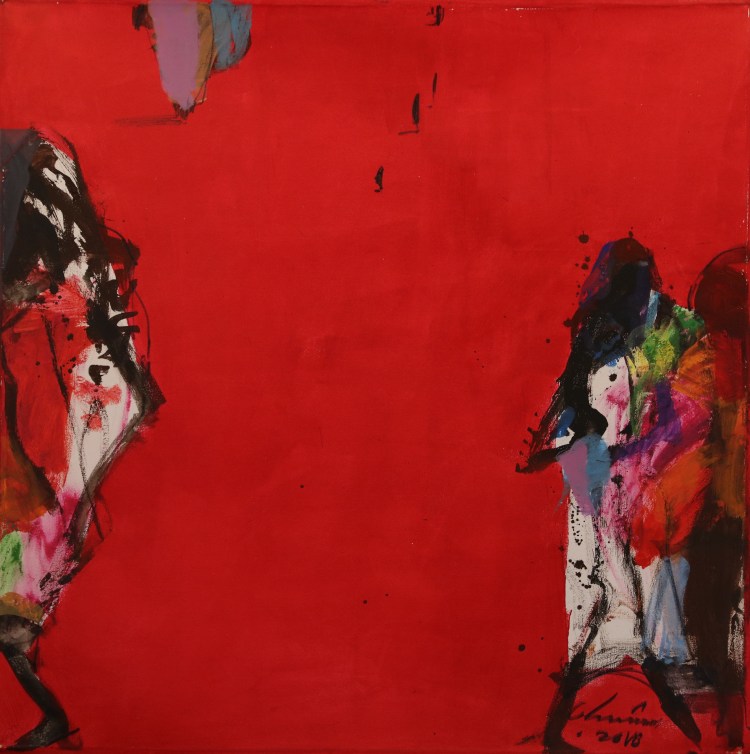
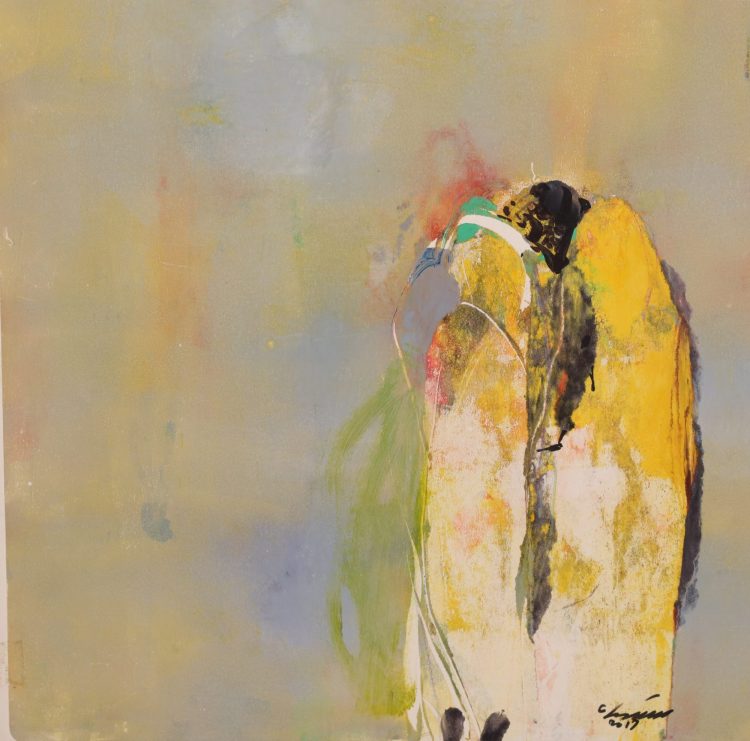
In the case of his artistic trajectory he drew his inspiration from his hometown and travels along the majestic river and the colours that it brings with its migratory fauna and diverse flora. It is in these landscapes where Diab first delved into the traditions and culture that composes the heartland of the Sudan. As a child using rudimentary and improvised materials, he knew he had to search further to develop his technique. He was lucky enough to have some travels as mentioned, but it wouldn’t be until his own investigations in the 80’s and 90’s that he would travel the country more extensively. Further trips in the early 2000’s would have him reencounter with the expansive scenery of Sudan and the different peoples that roamed the land. This inspired his latest style of work.
For Rashid Diab color is of utmost importance, it can be seen as his unique defining quality within the spectrum of sudanese painting styles. Interestingly it becomes hard to pin point Diab’s exact location within the history of Sudanese art. He is not recognized as belonging to any school of art, his process and movement through the artistic landscape has always been that of an individual with set goals, never forming part of any groups or mandates. Unlike the pioneers he didn’t study in England, but Spain and the only Sudanese artist at that. There was a higher focus on traditional techniques, part of the reason why he is inequivocably a master printmaker. All types of printing techniques he has mastered and in some cases even developed and produced his own advances. In all, his dream was to create those things that he did not have as child, like the art center and gallery, furthermore what he did not find in the university of Khartoum library, a history of Sudanese art…
His first exhibition was at the Africa Center in London 1976 whilst he was on a trip midway through his B.A. Today he has exhibtied in over 200 occasions, half of which solo shows and reaching almost every corner of the world. Exhibiting in several National museums and libraries as well as art fairs and biennials. Diab’s work is collected by the aforementioned institutions, private collectors and more. Recently by the Nairobi Contemporary Art Institute and the Ramzi and Saeda Dalloul Art Foundation (DAF).
Unfortunately, due to the catastrophic war that broke out on April 15th 2023 in Khartoum, Sudan, Rashid Diab had to flee his home, his life and country back to Spain where he keeps painting. This devastating and traumatic experience has changed his life for ever and the same goes for the people of Sudan whose lives have been flipped upside down in mere weeks.
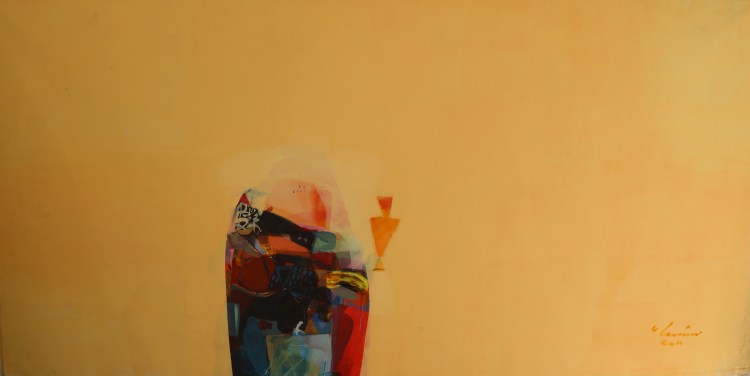
 Rashid Diab